
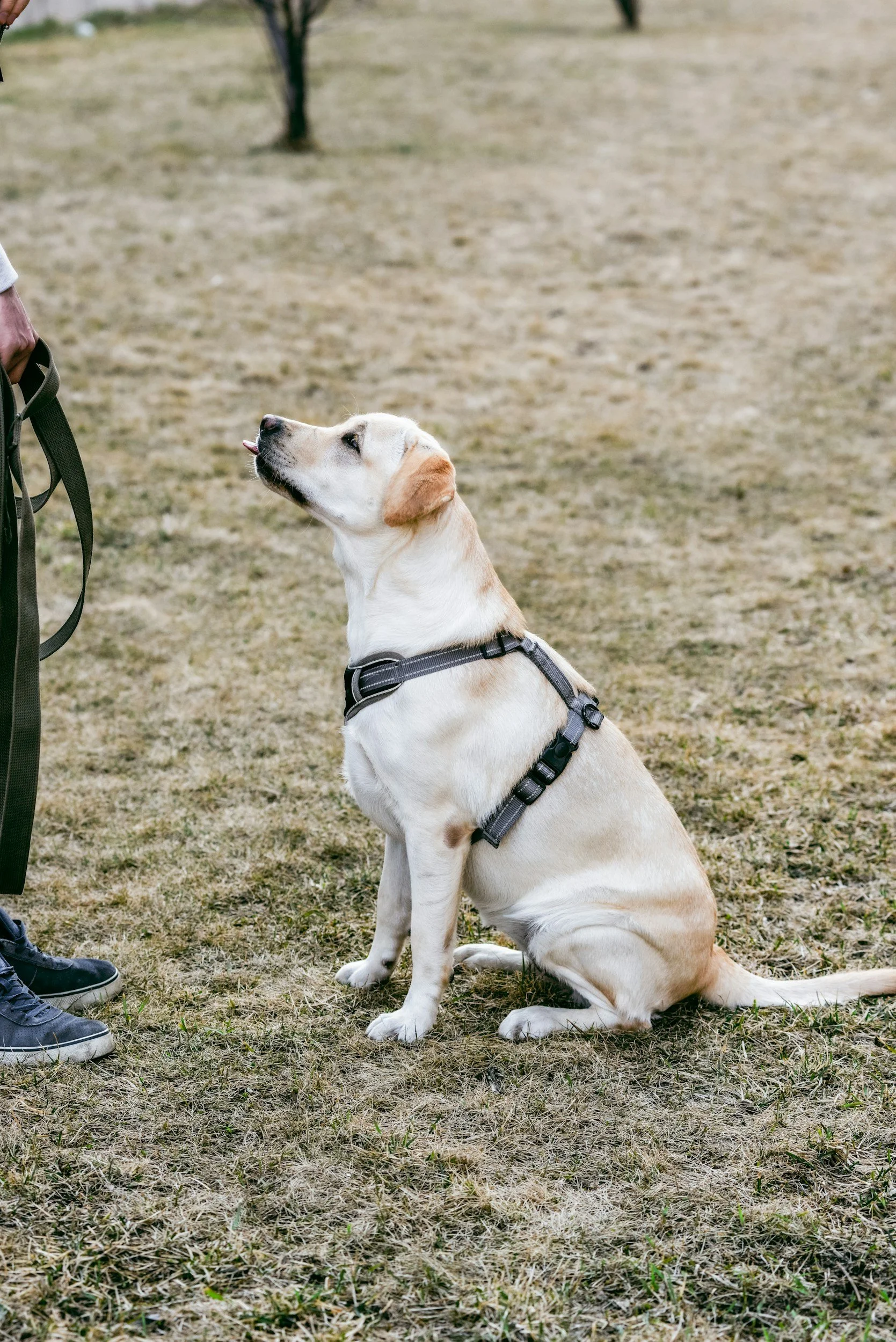
Distraction Training — The Missing Piece in Most Dogs' Obedience
Here's a scenario that almost every dog owner has lived through: your dog knows the command. You've practiced it dozens of times. They respond reliably in the backyard, in the living room, on a quiet street. Then a squirrel appears, or another dog trots by, or a kid runs past on a bike — and suddenly your dog has no idea you exist. The command that worked perfectly five minutes ago might as well have never been taught.
This is one of the most common and most frustrating gaps in dog training, and it has a name: a lack of distraction proofing. It's also one of the most important things we work on at Ridgeside K9 Charlottesville, because a dog who only obeys in perfect conditions isn't really trained for the world you actually live in.
Why Distraction Breaks Down Obedience
Dogs are not naturally wired to generalize. When a dog learns a command in the living room, they're learning it in the context of that specific environment — the smells, the sounds, the level of stimulation. When you change any of those variables significantly, you're effectively asking for something new. This is why a dog who has "mastered" sit at home can appear completely clueless when you ask for it on a busy sidewalk.
Add to that the fact that dogs are highly motivated by their environment — by prey drive, by social interest, by all the stimulating things the outside world offers — and you have a recipe for commands that evaporate the moment something interesting enters the picture.
The solution is not to keep practicing in controlled settings and hope the behavior magically transfers. The solution is systematic distraction training — deliberately teaching your dog to respond to commands in the presence of the things that currently blow their focus.
What Distraction Training Actually Looks Like
At Ridgeside K9 Charlottesville, distraction proofing is woven into every stage of our training programs. We don't wait until a dog has "mastered" a command in quiet settings before adding challenge — we build distraction tolerance progressively throughout the process. Here's how that works:
Starting with mild distractions. Early distraction work uses low-level environmental changes — a new location, a unfamiliar surface, mild background noise. The goal is to teach the dog that the command means the same thing regardless of context.
Gradually increasing intensity. As the dog's reliability grows, we introduce higher-value distractions: food on the ground, toys in the environment, movement nearby. Each successful repetition builds the dog's ability to focus under pressure.
Working with real-world triggers. For most dogs, the hardest distractions are other animals, other dogs, or fast-moving objects. We train with these specifically — not to eliminate your dog's prey drive or social interest, but to give you reliable communication even when those drives are activated.
Building duration under distraction. It's one thing for a dog to sit once with a distraction present. It's another for them to hold a stay for several minutes while the world moves around them. We build both.
The Role of the E-Collar in Distraction Training
One of the reasons we use the e-collar in our training programs is precisely because of distraction. When a dog is highly aroused — locked onto a squirrel, fixated on another dog — verbal commands alone often can't cut through. The e-collar gives us a communication tool that remains clear and consistent regardless of the dog's arousal level. Used correctly, at an appropriate level, it's not a punishment — it's a tap on the shoulder that says, "Hey, I'm still here, and this still applies."
Dogs who are trained with the e-collar in distraction-heavy environments develop a level of responsiveness that is difficult to achieve through other means. They learn that the rules don't change when something exciting happens — and over time, that understanding becomes automatic.
The Goal: A Dog You Can Trust Anywhere
The whole point of distraction training is to close the gap between the dog you have at home and the dog you need in the real world. A reliable sit in the backyard is a starting point. A dog who holds a down-stay while another dog walks past on the trail — that's a dog you can actually live with fully.
At Ridgeside K9 Charlottesville, every program we offer is designed to produce behavior that holds up in real life. Not just in ideal conditions. Not just when the world cooperates. In the messy, unpredictable, distraction-filled reality of everyday life with a dog in central Virginia.
Ready to Start?
If your dog needs structure, confidence, and clarity, our team is ready to help. Schedule your consultation with Ridgeside K9 Charlottesville today and see what’s possible.
